Credit-based licensing on Italian construction sites: proof is still the weak link
Qualifying the undertaking, identifying the person
From the credit-based licence to the site badge: what is in force, what is missing, and what changes in investigating a workplace accident
On 8 September 2026 INAIL published its data as at 31 July on workplace injuries and occupational diseases.
Analysis current as at 26 September 2026.
A note for readers outside Italy. This article deals with Italian occupational-safety legislation and its consequences for loss adjusting. Italian terms are kept where no exact equivalent exists, with an English gloss on first use. INAIL is the national institute insuring workers against occupational injury and disease; INL (Ispettorato Nazionale del Lavoro) is the National Labour Inspectorate; SIISL is the national digital platform for social and labour inclusion. RCO denotes employers’ liability cover, RCT public liability cover.
1. The INAIL figures, and the question that comes after the numbers
In the first seven months of the year, excluding students, 256,471 claims were reported for injuries occurring at work, against 244,495 in the same period of 2025, an increase of 4.9%. Commuting injuries numbered 58,870, up 7.1%. Fatal reports for injuries at work were 422, ten fewer than the 432 recorded in 2025; fatal commuting reports were 160, against 168.
Taking the whole Open Data aggregate, students included, injury reports reach 368,085 against 349,444 in 2025, an increase of 5.3%.
The figure rising most sharply, however, is that of occupational diseases: 69,796 reports against 59,857, or +16.6%. These are still provisional numbers and, as INAIL itself notes, they must be read with caution: they describe reports, not cases definitively recognised, and on their own they support no causal inference about the effectiveness of any particular reform.
For the subject examined here, the construction sector is more telling. Between January and July, reports of injuries at work in construction rose from 21,921 in 2025 to 22,382 in 2026, an increase of 2.1%; fatal reports rose from 67 to 76. With seventy-six deaths, construction ranks first among Italian sectors for fatal workplace injuries, ahead of transport and warehousing. These figures too are provisional and warrant no simplistic cause-and-effect reasoning. What they do make timely is a different question: after a serious event on site, how much can actually be established today about who was working there, for whom, and under what title?
It is a less statistical and far more practical question. And it is precisely where a loss adjuster’s investigation begins.
As will be seen, the answer depends on a measure which, almost a year after the decree that provides for it, has still not been adopted — and it is not the only one.
2. The patente a crediti is, first of all, a qualification system
The expression “points licence”, which entered common usage almost immediately, risks being misleading.
The heading of article 27 of Legislative Decree no. 81 of 9 April 2008 in fact reads: “System for the qualification of undertakings and self-employed workers by means of credits”. The distinction is not merely terminological.
A comparison with the Italian driving licence makes it plain. Article 126-bis of the Highway Code starts from an allocation of twenty points and allows it to be increased only through the absence of violations — two points per two-year period, up to ten. It is a purely punitive mechanism, in which good conduct is defined negatively. Article 27 works differently: the opening allocation is thirty credits and the ceiling one hundred, but the further seventy credits are earned through active and documented conduct. And the disqualifying threshold is not zero but fifteen credits: an undertaking must stop while it still holds half its original allocation.
Since 1 October 2024, undertakings and self-employed workers physically operating on temporary or mobile construction sites within the meaning of article 89(1)(a) must hold the licence, subject to the exemptions provided by law. Excluded, among others, are those supplying goods only or providing services of an intellectual nature, and undertakings holding SOA qualification in class III or above, whatever the category. Holding a SOA certificate of a lower class therefore does not exempt.
The opening allocation is 30 credits. Work on site is permitted, as a rule, with at least 15 credits, while seniority, an absence of credit-deduction measures, certifications, training and safety investment can take an undertaking up to 100.
This is what most clearly distinguishes the instrument from a mere penalty mechanism. The legislature does not confine itself to deducting points when something goes wrong: it attributes value to the organisational features and the investment that qualify an undertaking in preventive terms.
Seen this way, the additional credits also constitute a margin of resilience. An undertaking that has remained at its opening allocation and one that has progressively built its score do not face a future deduction in the same way.
The point should not, however, be overstated. A high score does not certify that every safety rule was observed on a particular site, just as an administrative breach does not of itself establish a causal link with a subsequent injury. The licence is an indicator of qualification; it is not an advance verdict on liability.
That distinction matters in loss adjusting as well.
3. Since 2025 the system has become stricter. But penalty, credit deduction and suspension must be kept apart
Decree-Law no. 159 of 31 October 2025, converted with amendments by Law no. 198 of 29 December 2025, made significant changes.
For an undertaking or self-employed worker operating without the licence, without an equivalent document, or with a score below 15 credits, the administrative penalty remains 10% of the value of the works, but the statutory minimum has been raised from €6,000 to €12,000. Where reduced payment under article 16 of Law no. 689/1981 applies, the amount falls to one third, and therefore to €4,000. Exclusion from public works for six months also remains.
More incisive still is the change concerning undeclared labour. For offences committed from 1 January 2026, point 21 of Annex I-bis provides for a deduction of five credits for each irregularly employed worker, irrespective of the number of days worked; point 24 adds a further credit per worker in aggravated cases, such as the employment of foreign nationals without leave to remain, or of minors.
Two clarifications, both contained in INL Note prot. no. 609 of 22 January 2026, deserve emphasis because practice tends to overlook them.
The first. For these cases alone, the deduction does not await a final measure but follows service of the inspection report. This is an important exception, because the ordinary regime governing other deductions remains different.
The second, and of even greater impact. For points 21 to 24 the cap that otherwise limits the total deduction applicable in a single inspection to twice the most serious breach does not apply, because the provision expressly states five credits “for each irregular worker”. The effect is multiplicative and unlimited: ten unregistered workers mean the loss of fifty credits — for an undertaking still at its opening allocation, the disqualifying threshold crossed in a single inspection.
The more serious injury events also call for a precise reading. Annex I-bis attributes five credits of deduction to an injury causing total temporary incapacity exceeding sixty days, eight to partial permanent incapacity, fifteen to total permanent incapacity, twenty to a fatal injury and ten to occupational disease. But the provision does not tie the loss of credits to the mere occurrence of the event: it requires that the event be the consequence of a breach of preventive rules, and the ordinary deduction is linked to the final measures contemplated by article 27.
Different again is precautionary suspension. Article 27(8) provides that “if injuries occur on the sites referred to in paragraph 1 resulting in the death of the worker or in permanent incapacity, whether total or partial, the National Labour Inspectorate may suspend, by way of precaution, the licence under this article for up to twelve months”.
These are therefore instruments that must not be conflated: the injury event, precautionary suspension, the finding of a breach, the finality of the measure and the credit deduction are distinct moments.
For a loss adjuster this sequence is not a technicality. It is part of the investigation.
4. The client’s verification duty: the date of the accident is not enough
A second aspect warrants particular attention.
Article 90(9)(b-bis) of Legislative Decree no. 81/2008 requires the client (committente) or the works manager (responsabile dei lavori) to verify that the executing undertakings and self-employed workers hold the licence — or the equivalent document — including in cases of subcontracting; for exempt parties, the SOA certification required by law must be verified.
That verification sits alongside, and does not replace, the assessment of technical and professional suitability required by point (a) of the same paragraph and by Annex XVII.
INL Note prot. no. 9326 of 9 December 2024 clarifies a particularly relevant point: for the purposes of the client’s sanctioned obligation, what matters is the position existing at the time the works were awarded. It states that “where the qualifying title lapses through suspension, revocation or a score below 15 credits after the award of the works, the administrative penalty does not apply”.
If, therefore, the undertaking held no licence, or already held fewer than 15 credits, at the time of the award, the failure to verify has consequences for the client. If instead the licence is suspended, revoked or falls below the threshold only afterwards, that penalty is not automatically transferred to the client.
From this follows a further practical requirement: to identify the moment at which the award was actually perfected, which does not necessarily coincide with the date on the contract.
The consequence is precise. In an adjuster’s file it is not enough to obtain the licence “as of today”, nor merely to establish the score at the date of the accident. At least three temporal snapshots are needed:
- the undertaking’s position at the time of the actual award;
- its position during execution and site access;
- its position at the date of the event, together with any measures taken in the meantime.
These snapshots answer different questions and cannot be substituted for one another.
5. The site badge: the duty to identify already exists; what is missing is full digital traceability
It is here that the 2025 reform presents, as matters stand, its most interesting feature.
The duty to identify workers does not originate in 2025. Legislative Decree no. 81/2008 already requires, in contracting and subcontracting, an identification badge bearing a photograph, the worker’s particulars and the name of the employer. Law no. 136/2010 further regulated the badge in subcontracting relationships.
Decree-Law no. 159/2025 does, however, make a qualitative leap. It provides that the badge carry a unique anti-counterfeiting code, that it may also be made available in digital form through national systems interoperable with SIISL, and that it be embedded in a system capable of supporting the control and monitoring of labour flows.
The INL has said so expressly: the new badge does not replace the identification badge already required by law but adds the unique-code feature to it. Full operation of the new system depends on a ministerial decree that must define its application, the controls, security, the technologies employed and the categories of information processed.
And it is here that the most significant present-day fact emerges.
6. The missing decree is not one. There are three, and all concern article 3
The converting law entered into force on 31 December 2025, and article 3(3) required the implementing decree to be adopted within sixty days: by 1 March 2026.
The check can be made by anyone in a matter of seconds. The Presidency of the Council of Ministers — Department for the Government Programme maintains a public database of the implementing measures required by each piece of primary legislation, recording whether each has been adopted. Querying it for Decree-Law no. 159/2025, as at 26 September 2026, the picture is as follows.
The decree requires twelve implementing measures. Two have been adopted. And the three measures required by article 3 — the article governing the site badge and amending the patente a crediti — are all three recorded as not adopted.
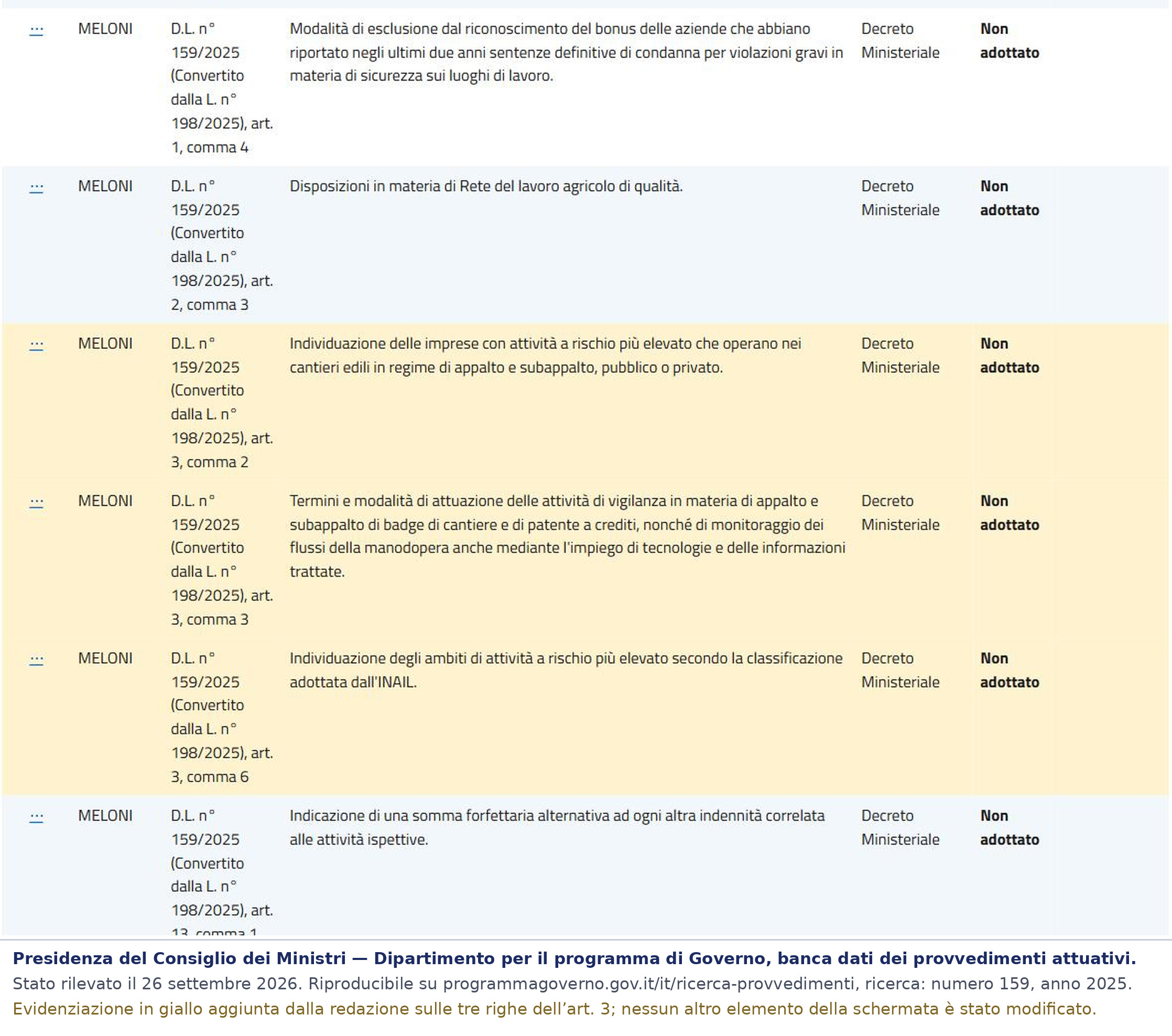
| Source | Subject matter | Status |
|---|---|---|
| art. 3(2) | Identification of higher-risk undertakings operating on sites under contract and subcontract | Not adopted |
| art. 3(3) | Terms and arrangements for supervision of the site badge and the credit-based licence, and for monitoring labour flows | Not adopted |
| art. 3(6) | Identification of higher-risk fields of activity according to INAIL’s classification | Not adopted |
This is not an isolated omission. Among the measures not adopted are the one intended to exclude from the INAIL premium discount those undertakings convicted in the previous two years of serious safety breaches (art. 1(4)), and the one that must set out how undertakings with more than fifteen employees are to report aggregate data on near misses and the corrective action taken (art. 15(1)) — that is, the instrument through which the system was meant to learn from events that caused no harm.
Adopted, by contrast, are the decree on INAIL premium-rate variation (art. 1(3)) and the decree on the registration of foreign workers with SIISL (art. 14(6)).
The overall picture is therefore this. The provisions that operate directly — the higher statutory minimum, the new deduction for undeclared labour, the counting of health checks within working hours — are in force and producing effects. The provisions that required an implementing measure, and which concern almost entirely the knowability of the site, are not operational.
The traditional badge accordingly remains compulsory. What is not yet operational is the technological system meant to turn it from a simple identity document into a structured and verifiable source of information.
The difference is substantive. A paper badge allows a person to state who they are and for which undertaking they work. A unique, interoperable and technologically traceable system is designed to make that statement checkable.
And this is precisely where the regulatory question becomes a loss-adjusting question.
7. When the name on the document does not match the person on site
Practical experience shows why identification cannot be treated as a merely formal requirement.
That the physical reality of a site may diverge from the documentary one is, moreover, no exceptional circumstance: it is what inspection activity records with regularity, and the numbers are explicit.
The INL’s annual report for 2025 records 44,063 inspections commenced in construction. Of the 32,492 concluded, 71.8 per cent ended with at least one irregularity being found. In the same year 4,949 orders suspending business activity on site were issued: more than 37 per cent for serious safety breaches, and in 1,241 cases for safety breaches and undeclared labour together. Nationally, workers found entirely without any notification of their employment relationship numbered 18,397, an increase of 26 per cent on 2024.
Seven inspected sites in ten, then, show at least one irregularity. These are numbers describing a structural phenomenon, not an isolated pathology. And they translate immediately into adjusting terms: on a site under contract and subcontract, the list of people entitled to be there and the list of people actually there are not necessarily the same list.
The case that follows makes it concrete.
In a serious loss handled by this firm, two workers died inside a site cabin in which they were sleeping. Only the investigation that followed established that the people actually present did not correspond to those shown in the documentation formally available, and that their employment positions were irregular.
The case is referred to here deliberately without identifying detail, because what matters is not the individual episode but the evidential problem it exposes.
Leaving aside the legal characterisation of the event and the causes of death, one fact proved decisive: before determining which duties had been breached, it was necessary to determine who the people present actually were and for whom they were working.
This is no secondary step.
The identity of the worker and his actual attribution to an undertaking can affect the reconstruction of the entire chain: the employment relationship, the contract and subcontract, the identification of positions of guarantee, preventive duties, training, health surveillance, authorised presence on site, the liability of the various parties and — on the separate insurance plane — the identification of the covers potentially engaged.
They may also bear on any recourse action by INAIL, and on the distinction, to be drawn on the basis of the particular policy, between positions falling under RCO, under RCT or under other sections.
Naturally, irregular employment does not of itself determine either civil liability or insurance cover, just as formal regularity does not exclude a finding of liability. But a mistaken reconstruction of identity, or of who the real employer was, can steer the file from the outset towards the wrong parties, the wrong duties and the wrong covers.
This, in our view, is the real adjusting significance of an interoperable badge.
It is not simply a matter of knowing whether a worker is wearing the badge the law prescribes. It is a matter of being able to verify that the person physically present is indeed the person identified, that the declared relationship is attributable to that person, and that his presence on the site forms part of a chain of parties that can be reconstructed.
8. The adjuster’s file after the patente a crediti
The new rules do not replace traditional investigation. If anything, they make it more layered.
In serious site losses the technical analysis of the mechanism remains central: the state of the premises, temporary works, plant and equipment, fall-arrest systems, installations, operating procedures, interference between activities, the organisation of the work.
But that reconstruction must be accompanied, from the earliest hours, by a reconstruction of the site’s people and paperwork. In our experience, the questions the file must be able to answer are at least five:
- Who was actually present on site? Not only who was authorised or listed, but which people were physically there and on what basis.
- For whom was each person working? The actual chain must be reconstructed between client, main contractor, executing undertakings, subcontractors, self-employed workers and, where they emerge, informal arrangements.
- What was the position of the relevant undertakings at each point in time? Licence, score history, any SOA certificate and its class, suspensions, revocations and credit-deduction measures must each be placed at the correct date.
- What verifications had the client and the other safety duty-holders carried out? Verifying the licence does not exhaust the assessment of technical and professional suitability, and does not replace the DVR, POS, PSC, DUVRI where applicable, training, health surveillance, appointments and the other documents required for the particular site.
- What relationship exists between any irregularity found and the event? This is the step that separates mere administrative non-compliance from the reconstruction of civil liability and causation.
Depending on the case, the exercise may require cross-checking personnel records, mandatory employment notifications, the Libro unico del lavoro, safety documentation, the preliminary notification, contracts and subcontracts, access registers or systems, delivery notes, available photographs and footage, the reports of the authorities that attended, and witness statements.
None of these sources, taken alone, is necessarily decisive. It is their mutual consistency that builds the proof.
It is at this intersection — between the technical mechanism of the loss, the organisation of the site, contractual relationships, employment status and the reading of the insurance cover — that the adjuster’s work becomes something other than the collection of documents.
9. The time factor: a site does not stay the same after the event
In workplace losses, time is an evidential variable.
The site an adjuster sees in the first hours is not the site he will find a week later. Temporary works may be altered, materials removed, machinery moved, work resumed. But the documentary dimension changes too.
As the days pass, the chain of contracts and subcontracts is reconstructed, statements are coordinated, documentation arrives tidy and complete. All of that is necessary and normal, but for that very reason documentation obtained later cannot substitute for establishing what existed and was available at the moment of the event.
Adjusting experience therefore teaches that in the more serious losses three levels of proof must be “frozen” as early as possible: the physical state of the site, the population actually present, and the documentary position as it then stood.
It is a rule set to become more important still with digitalisation.
10. What a genuinely interoperable badge would change
When the system contemplated by article 3 of Decree-Law no. 159/2025 is fully implemented, the badge could materially change the quality of the investigation.
Today the presence of a person not properly recorded must often be reconstructed through a range of indirect elements: witness statements, photographs, recordings, company records and checks made after the event.
A unique digital system can move at least part of the investigation from the plane of statements to the plane of data. That does not mean the adjuster’s investigative work disappears. It means having one further source, potentially far more robust, against which to test the others.
It is nevertheless necessary to avoid anticipating what the legislature has not yet settled. It will be for the implementing decree to establish what information is actually to be processed, how labour flows are to be monitored, who may access the data, on what conditions, and for how long it is to be retained.
These points will have direct adjusting significance. The retention period in particular will determine the window within which the data can be obtained. The access arrangements will determine who may request it and by what procedure. And the architecture of the system will determine whether it will be possible to document the worker’s identity alone, or also his actual presence on a given site at a given moment.
Until the decree is adopted, attributing to the badge functions wider than those the law expressly provides would be to anticipate conclusions that are not yet tenable.
11. The real issue: from qualifying the undertaking to identifying the person
The patente a crediti introduced an important principle into Italian construction-site safety: not all undertakings are to be treated as equivalent in terms of preventive qualification.
The 2025 reform reinforced that framework. The penalty for operating without title or below threshold has been raised; undeclared labour now produces far more incisive deductions, and without a cap; information from the enforcement authorities enters the system more quickly.
But a system for qualifying the undertaking solves only part of the problem. After a serious loss it must be possible to establish, with equal reliability, which people were actually on the site, for which undertaking they were working, and through what relationship they entered the contracting chain.
The experience this firm has built in complex losses shows how decisive that step can be. The documentation formally available does not always describe the physical reality of the site accurately. And it is precisely where the two diverge that the adjuster’s work carries its greatest value.
For this reason an interoperable badge should not be read as one more administrative formality. Properly implemented, it can become an instrument of proof.
As matters stand today, however, this part of the system is not complete, and the fact is not open to argument: of the twelve implementing measures required by Decree-Law no. 159/2025, two have been adopted, and none of the three relating to article 3. The licence allows the undertaking to be qualified; the penalties are operational; the new deductions for undeclared labour are operational. What would have made the site knowable is not.
The consequence is simple, but material. It is not enough to know which undertaking was entitled to enter the site. It must be possible to know, with the same reliability, who actually entered it.
For anyone required to reconstruct an accident after it has happened, this is probably the most important point in the whole reform.
Principal legislative and administrative sources
- Legislative Decree no. 81 of 9 April 2008, articles 18, 26, 27, 89 and 90; Annexes I-bis and XVII.
- Decree-Law no. 19 of 2 March 2024, converted with amendments by Law no. 56 of 29 April 2024.
- Ministerial Decree no. 132 of 18 September 2024.
- INL Circular no. 4/2024.
- INL Note prot. no. 9326 of 9 December 2024.
- Decree-Law no. 159 of 31 October 2025, converted with amendments by Law no. 198 of 29 December 2025.
- INL Note prot. no. 609 of 22 January 2026.
- INL Circular no. 1/2026.
- Legislative Decree no. 285 of 30 April 1992, article 126-bis.
- INAIL, monthly data on workplace injuries and occupational diseases as at 31 July 2026, published 8 September 2026.
- National Labour Inspectorate, Annual Report on supervisory activity in labour and social legislation — year 2025, published 23 April 2026.
- Presidency of the Council of Ministers — Department for the Government Programme, database of implementing measures, Decree-Law no. 159/2025, status recorded 26 September 2026.
Giorgio Zappa
Zappa & Company S.r.l. — Seregno (MB), Italy
g.zappa@zappa.srl — +39 0362 23 22 83
The accompanying images are taken from archives that allow free use, including commercial use and without any attribution requirement, and from public institutional sources. Any graphic highlighting is editorial.
© 2026 Zappa & Company S.r.l. All rights reserved. Summary, quotation and reproduction of extracts are permitted for purposes of criticism or discussion within the limits of article 70 of Italian Law no. 633 of 22 April 1941, provided the title, the author and the source are stated; full or substantial reproduction requires written permission.